
This article is written from the perspective of an EU-qualified attorney (admitted to the Slovak Bar) and managing partner of a UAE-licensed corporate services provider, someone who works on both sides of the structure.
Why this topic deserves a fresh look in 2026
The UAE has been known among European business owners for years in two guises: as a zero-tax haven, or as an exotic destination for the very wealthy. Both images are out of date today, and both always oversimplified.
What has changed
Since 2024, the UAE has applied a federal corporate income tax of 9% on profits above AED 375,000. Since 2023, UAE companies have been subject to transfer pricing rules built on the OECD Guidelines. From 2025, the Pillar Two regime (the second pillar of the OECD’s global tax reform) is in effect, introducing a global minimum tax of 15% for large multinational groups.
The Economic Substance Regulations (ESR), which framed the tax landscape from 2019 to 2022, have been discontinued in their original form. The substance requirements have moved directly into the UAE Corporate Tax Law, particularly into the conditions for the Qualifying Free Zone Person status.
Zero per cent has not disappeared, only become conditional
Zero per cent has not disappeared. It has become conditional. A Free Zone company that meets the Qualifying Free Zone Person (QFZP) criteria can continue to apply 0% corporate tax to its qualifying income, with no time limit. The conditions, however, are specific, the definitions are narrow, and the obligations are real.
Who this guide is for
This article is a practical guide for established European business owners considering a UAE structure. It is not a marketing piece. It shows where UAE structures work, where they do not, and, perhaps most usefully, where the client’s initial idea diverges from what is legally defensible.
The guide is aimed at owners of European operating companies (typically Ltd, GmbH, s.r.o., S.r.l., or similar) with real cross-border activity or its credible potential. It is not aimed at sole traders, digital nomads, or businesses oriented exclusively to a domestic market. A UAE structure carries real fixed costs, and below a certain profitability threshold it simply does not pay off. We return to that threshold later.
An important clarification
This article covers the UAE side of the structure. The home-country side (domestic corporate income tax, CFC analysis at company level, participation exemption for foreign dividends, exit tax on transferred assets, transfer pricing under domestic law, reporting obligations, withholding tax analysis) is the domain of the client’s local tax adviser. INCORPORTAS does not replace that adviser; we work alongside them.
Tax optimization, tax planning, aggressive tax planning
In European public debate, topics around international structures are often blended into one pot. The result is either moral outrage at “tax havens” or naive glorification of “zero tax.” Neither is useful. Let us start by separating three concepts.
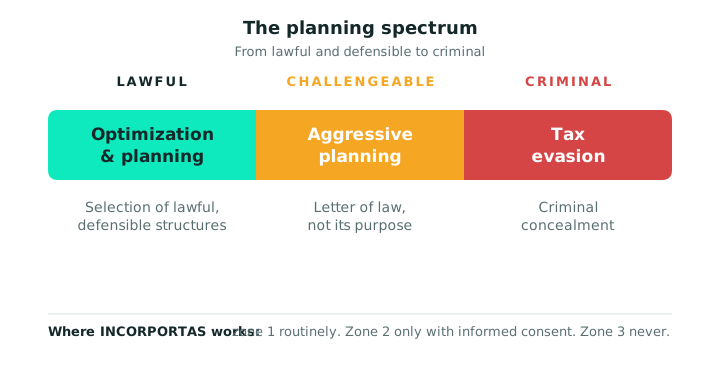
1. Tax optimization
The selection of the most favourable of several lawful options. It has commercial logic, it has documentation, it has arm’s-length pricing. A European manufacturer who relocates its regional functions to a UAE entity with real operations and properly set transfer pricing is engaged in optimization. Courts across the EU, the UK, and the UAE have repeatedly confirmed that taxpayers are not required to choose the most expensive path.
2. Tax planning
The broader discipline. It is the structuring of activities in advance, in a way that anticipates tax consequences and aligns them with business goals. In practice optimization and planning overlap, and virtually every serious commercial undertaking contains both layers.
3. Aggressive tax planning
The third category. It refers to arrangements that formally comply with the letter of the law but contradict its purpose. The hallmark is that economic substance is thin or absent and the arrangement stands primarily on its tax outcome. Aggressive planning is not a criminal matter (that is tax evasion), but it is more vulnerable to challenge under general anti-abuse rules: ATAD GAAR transposed into the national tax law of every EU member state, and the UAE GAAR in the Corporate Tax Law itself.
In practice, optimization and planning typically survive audit. Aggressive planning is harder to defend in an audit, and the outcome depends on the quality of documentation, the intensity of economic substance, and sometimes on how aggressively the local tax authority pursued such structures that year. A detailed analysis of the three categories, ATAD GAAR, UAE GAAR, and the line to criminal tax evasion is in tax planning vs tax avoidance under ATAD.
Where we sit
We are not dogmatic. Optimization and planning are routine for our clients, and we do not consider them a grey zone; they are standard parts of international business. We do not condemn aggressive planning categorically. We treat it as a higher-risk profile and we tell the client so openly: how likely is the challenge, who bears the burden of proof, what the defence would cost, when it is worth it and when it is not.
What we require from the client is informed consent. If a client understands the risk, can live with its consequences, and knowingly accepts it, the decision is theirs. Not the lawyer’s, who does not bear the risk anyway.
What we categorically refuse is tax evasion. That no longer belongs in the planning category in any form. We do not handle criminal matters.
Five myths about UAE structures
Most UAE structures do not fail because of bad legislation. They fail because the owner entered with the wrong expectation. Over years of working with clients, five misconceptions return so reliably that they deserve to be named directly.
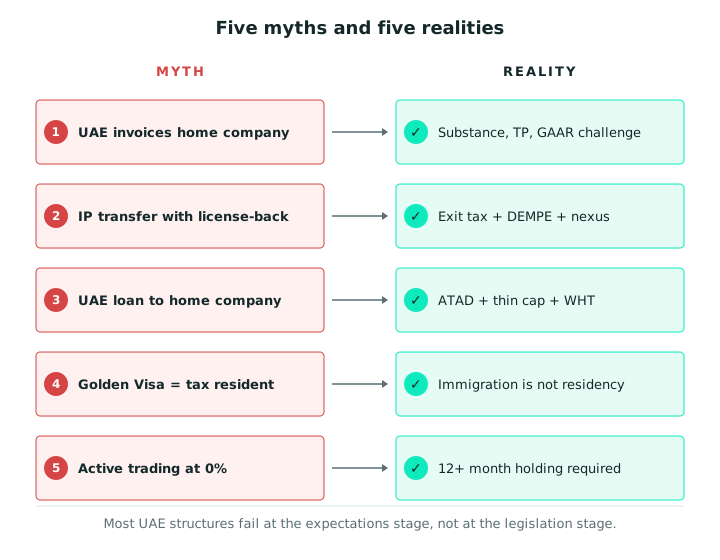
Myth 1: “A UAE company will invoice my European business, and I will have a deductible expense at home.”
The reasoning is simple. Set up a UAE company, have it invoice the European operating business, deduct the invoice at home, and tax the income in the UAE at 0% or 9%. The arithmetic looks compelling.
The problem typically appears in three places:
- Substance. The UAE company needs proportionate economic substance: real premises, real employees, and real activities, so it can be assessed as the actual recipient of the income. In 2026, substance requirements no longer live in the ESR but directly in the CIT Law, especially in the QFZP conditions. Proportionate substance means real people taking real decisions in the UAE, not a registered address.
- Transfer pricing. TP rules require that the service actually be supplied, that its price match the arm’s length principle, and that the arrangement have commercial purpose beyond profit shifting. The most common challenge target is invoices labelled “management services” or “consulting” without evidence of who did what work and when.
- Home-country anti-abuse rules. The home tax authority can deny the deduction under general expense rules, specific non-deductibility provisions, or, in sharper cases, under general anti-abuse rules (GAAR). The invoice can be formally issued and paid and still be disallowed.
The outcome is typically the same: tax assessment, late-payment interest, and penalties, often several years after the structure was built.
The substance framework is detailed in Substance rules in the UAE, transfer pricing on intra-group transactions in Transfer pricing in the UAE, and the CFC framework in CFC rules and UAE entities.
Myth 2: “I’ll transfer my IP or software to a UAE company and license it back.”
This variant is most common among European tech firms. The owner has developed valuable intellectual property through the European company (software, SaaS platform, brand, patent, customer database) and wants to transfer it to a UAE entity. The UAE entity then licenses the IP back to the original European company, to third parties, or both. The benefit looks twofold: tax deductions for past R&D costs remain at home, and future royalty income is taxed in the UAE at 0% or 9%.
The catch: exit tax on IP transfer
The value of IP developed in the European company cannot be moved abroad without tax consequences. Exit tax provisions transposed from ATAD Article 5 in every EU member state require the transferring company to recognise the fair market value of the IP and tax the difference between book value and fair market value as a deemed realised gain. The transfer is assessed as if it were a sale at arm’s length.
Clients are often surprised by the size of the resulting tax bill. Valuable IP is valuable precisely because it generates future income, and tax authorities legitimately want to tax the present value of those future earnings before the asset leaves the jurisdiction.
Additional complexity layers
Beyond exit tax, several other questions arise:
- Royalty payments between related parties require TP documentation and must be comparable to independent market transactions.
- Withholding tax is governed by the home-country to UAE double tax treaty. Rates for royalties (typically 5% to 10%) are not zero.
- The UAE entity that holds the IP must satisfy DEMPE criteria under OECD Transfer Pricing Guidelines: it must actually perform Development, Enhancement, Maintenance, Protection, and Exploitation functions on the IP. Mere registration is not enough.
- The same rules apply when the UAE entity licenses to third parties. The existence of an independent payer does not cure a weak underlying transfer.
Structuring IP through the UAE is one of the strategically most interesting engagements we handle. If you are considering an IP move, contact us. We will work through whether and how it makes sense in your case, and what needs to be prepared so that the structure is defensible to the tax authority from day one.
A detailed analysis of exit tax, IP valuation, the OECD modified nexus approach, the DEMPE framework, and the compliant migration sequence is in Exit tax on IP transfers to the UAE. Specifically for European SaaS founders, the framework is in UAE tax setup for SaaS founders.
Myth 3: “The UAE company will lend to my European company, and the interest will reduce my domestic tax base.”
In this variant, the UAE entity lends to the European operating business (or another related party) and the interest paid at home is deducted, shifting profit to the UAE.
Several anti-abuse mechanisms come into play at once:
- Interest deduction limits (ATAD). The deductibility of interest paid to related parties is capped, typically at 30% of tax EBITDA, with specific thresholds and carry-forward rules.
- Thin capitalisation rules. Apply where the debt-to-equity ratio is unfavourable.
- Withholding tax. Applies to interest paid to related parties under the home-country to UAE treaty.
- Transfer pricing. The interest rate must reflect market terms. The UAE lender cannot charge an artificially high rate just to inflate the home-country deduction.
- Lender substance. The UAE entity as lender must have substance matching the finance function: real decision-making capacity, adequate capitalisation, and relevant expertise.
Intra-group financing through the UAE is not inherently flawed. Treasury and financing functions are explicitly among QFZP Qualifying Activities. Execution is challenging, however, and most proposals clients bring fail to meet these strict conditions. The framework for UAE treasury and headquarter services for an international group is in UAE headquarter services.
Myth 4: “I have a Golden Visa, so I’m a tax resident of the UAE.”
This is perhaps the most consequential myth, because it touches the personal tax position of the owner, not just the corporate structure.
Immigration status versus tax residency
A UAE residence visa, including Golden Visa, is an immigration status. It gives the right to reside in the UAE, open bank accounts, sponsor family members, and access other services. By itself, it does not make the holder a UAE tax resident.
UAE tax residency is determined under UAE Tax Residency Regulations (Cabinet Decision 85/2022) and evidenced through a Tax Residency Certificate issued by the UAE Federal Tax Authority. The main criteria are two: either 183 days of physical presence in the UAE during a 12-month period, or 90 days of presence combined with a centre of financial and personal interests in the UAE. These tests are separate from visa status and require a genuinely relocated life.
The home-country side
Home-country tax residency typically continues until the individual genuinely severs the ties that established it: usually domicile, habitual abode, or physical presence test (typically 183 days per year). If at least one test is met, the individual remains a home-country tax resident regardless of what other countries say.
In dual residency between the home country and the UAE, the tie-breaker rules under Article 4 of the relevant double tax treaty apply. They sequentially assess permanent home, centre of vital interests, habitual abode, and finally nationality. They do not automatically favour the country that issued the most recent residence permit.
A common outcome is dual residency: the individual remains taxable in the home country despite having a UAE visa and sometimes a UAE tax certificate. Unwinding such a situation later is substantially more expensive than setting it up correctly from the start.
A detailed analysis of the residency tests under Cabinet Decision 85/2022, tie-breaker analysis under the typical EU member state to UAE treaty, and the practical migration sequence is in UAE tax residency.
Myth 5: “I’ll trade crypto, equities, or forex actively through a UAE company at 0%.”
This myth reaches a different audience than the first four: not owners of operating businesses, but investors and traders who have heard the UAE offers a 0% regime on asset-related activities. The reasoning typically runs: set up a UAE Free Zone company, capitalise it, trade crypto, equities, or forex through it, and benefit from QFZP.
There are two distinct problems here, both substantial.
Problem 1: the company level
Among Qualifying Activities is “holding of shares and other securities for investment purposes.” Two words matter together: holding and investment. Their combination excludes active trading. The position must be held passively, with the goal of long-term capital appreciation, not short-term speculation.
The relevant Ministerial Decisions define investment character through a holding period of 12 months, or through demonstrable intent to hold the asset for at least 12 months. The second condition matters: this is not a rigid test that disqualifies every position sold earlier, but an assessment of the investor’s actual intent, supported by documentation (investment policy, board resolutions, actual holding period in aggregate).
Positions traded actively, without an investment intent, are not classified as Qualifying Income, and the income from their active trading is subject to the standard 9% rate above AED 375,000.
In practice, this means for the European candidate:
- Equities. Holding equities as a long-term investment (12+ month intent) is a Qualifying Activity and can benefit from the 0% regime. Active trading of equities is not a Qualifying Activity.
- Crypto. Current UAE rules explicitly include crypto-assets among assets that can be the subject of investment holding, on the same basis as equities. Long-term investment holding of crypto-assets through a UAE company at 0% is therefore possible. Active daily crypto trading is not.
- Forex. Foreign currency does not have the character of a security in the classical sense, and active forex trading is not a Qualifying Activity. Passive long-term holding of foreign currency as an investment (for example, currency diversification of family wealth within a family office structure) is theoretically defensible under the broader investment management framework, but in practice it is rare. Most business owners coming to us with this question want to trade currency actively, not hold it passively.
In short: holding equities, crypto, or other qualifying assets through a UAE company at 0% is possible if the 12-month investment holding or demonstrable intent is satisfied. Active trading is not.
Problem 2: the residency of the company itself
The second problem is more serious. If the ultimate beneficial owner of the UAE company is also its director and actively trades from abroad (sitting in a European country and executing trades through a computer connected to a broker), the place of effective management of the company is where the trader (and director) physically sits, not where the company is registered. Strategic decisions about the company’s activity are taken outside the UAE.
Under the dual-residency tie-breaker rules in the relevant treaty and home-country domestic law, the company will be assessed as a tax resident of the home country. The UAE company then becomes fully taxable on worldwide income at home-country corporate rates, regardless of holding a UAE license. The UAE tax regime becomes irrelevant in such a case.
The risk can be mitigated in only two configurations: either the trader is physically present in the UAE and decisions are taken there, or it is a fully automated algorithmic system actually located and operated in the UAE (with proportionate substance: servers, operations, monitoring). Anything else returns the problem.
When it actually works
UAE holding structures can legitimately function where the investor is long-term, holds positions for at least 12 months in a buy-and-hold strategy, with real substance in the UAE and an ultimate owner who is genuinely a UAE resident. Suitable cases include family office structures, long-term equity portfolios, private equity interests, and long-term real estate holdings. Not day trading, not short-term crypto speculation, at least not without the owner’s personal relocation.
QFZP conditions and the list of Qualifying Activities are detailed in QFZP conditions. Place of effective management and the residency test for the company itself are in Place of effective management.
When zero per cent in the UAE is actually zero per cent
The most attractive feature of the UAE tax system, and the most often misunderstood, is the still-available 0% corporate tax rate. You are not mistaken; it does apply. But it is not automatic, and the path to it has become specific.
The baseline framework
The general UAE corporate tax framework works as follows:
- Taxable income up to AED 375,000: 0%
- Taxable income above AED 375,000: 9%
This is the starting point for both Mainland and Free Zone companies that do not satisfy the preferential regime conditions.
The route to 0% above AED 375,000: the QFZP regime
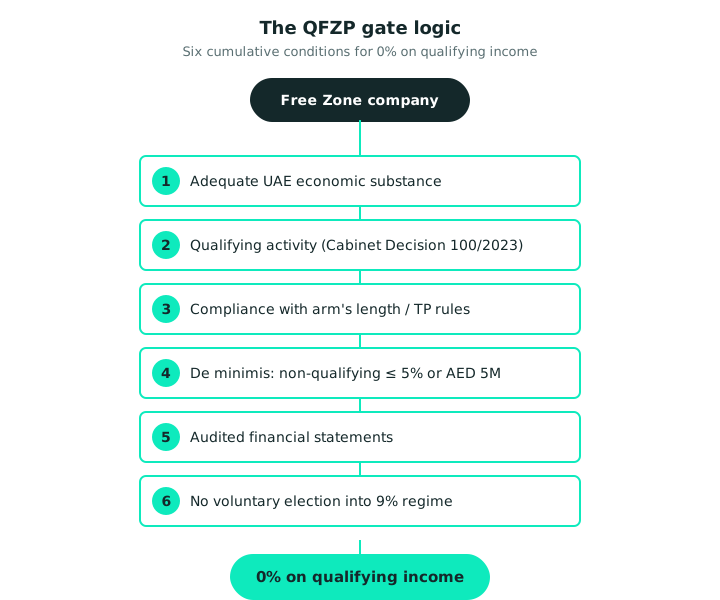
The route to a true 0% rate on income above AED 375,000 is the Qualifying Free Zone Person (QFZP) regime. A Free Zone company that meets the QFZP conditions applies 0% corporate tax to its Qualifying Income and 9% to its Non-Qualifying Income. There is no cap on Qualifying Income. QFZP can apply at 0% indefinitely, as long as the conditions hold.
QFZP conditions in brief
- Adequate economic substance in the UAE (physical premises, qualified employees, core income-generating activities performed in the UAE).
- Income from Qualifying Activities defined in Cabinet Decision 100/2023 and Ministerial Decision 229/2025.
- Compliance with the arm’s length principle and transfer pricing documentation.
- Compliance with the de minimis rule: non-qualifying revenue must not exceed 5% of total revenue or AED 5 million, whichever is lower.
- Audited financial statements.
- No voluntary election into the 9% regime.
The six cumulative conditions are explored in detail in QFZP conditions.
The most relevant Qualifying Activities for European clients
Ministerial Decision 229/2025 defines 14 Qualifying Activities. The following seven are most often relevant in practice for European business owners. The complete list of 14 activities with definitions, exclusions, and interactions is in QFZP conditions.
Manufacturing and processing of goods or materials
Activities involving the transformation of raw materials or semi-finished goods into finished products through a physical production process in the UAE. For European industrial firms this is one of the strongest routes into the UAE: production naturally requires premises, machinery, employees, and equipment, which simultaneously satisfy the substance requirement. The UAE has made industrial production a deliberate national strategic priority through the Operation 300bn programme and Industrial Strategy 2031. Specialised industrial Free Zones (notably KEZAD and ICAD in Abu Dhabi, JAFZA Industrial and Dubai Industrial City in Dubai) combine a QFZP-eligible tax regime with direct access to deep-sea ports (Khalifa Port, Jebel Ali) and proximity to fast-growing markets in the Gulf, South Asia, and East Africa.
Trading of Qualifying Commodities
The activity involves trading in listed commodities (metals, minerals, industrial chemicals, energy commodities, agricultural commodities, associated by-products, and environmental commodities) for which a Quoted Price exists, whether through a Recognized Commodities Exchange Market or a Recognized Price Reporting Agency. The commodity does not need to be in raw form, and physical listing on an exchange is not required, provided a Quoted Price exists. Goods packaged for retail sale are excluded from this activity.
Distribution of goods from a Designated Zone
The activity involves distribution of goods that have been brought into a Designated Free Zone, to a customer who resells or processes them. Two key conditions: the goods must pass through a Designated Zone (not just any Free Zone), and the end recipient must be a further business entity (B2B), not a consumer. This regime is typical for regional distribution from the UAE into MENA, Asian, and African markets. See UAE distribution hub for detail.
Logistics services
Activities include transport, warehousing, cargo handling, freight forwarding, and related services. For European firms with international supply chains, a UAE logistics entity combines QFZP status with access to deep-sea port and aviation infrastructure (Dubai International Airport, Al Maktoum International).
Headquarter services to Related Parties
The activity includes central group management, strategic decision-making, managerial services, and supporting administration for related parties within an international group. The key phrase is Related Parties. Headquarter services to unrelated third parties (e.g., independent management consulting) do not fall under this Qualifying Activity. See UAE headquarter services for detail.
Treasury and financing services to Related Parties
The activity includes intra-group financing, cash pooling, foreign exchange risk management, liquidity management, and similar financial functions for related parties within the group. The same Related Parties restriction applies as for headquarter services. Commercial financial services to third parties are a separately regulated activity and do not fall under this Qualifying Activity.
Holding of shares and other securities for investment purposes
The activity includes passive long-term holding of shares, bonds, and other securities with the goal of capital appreciation. The definition of investment purpose is satisfied through actual holding period (12 months or longer) or demonstrable intent. Active trading does not fall under this Qualifying Activity (see Myth 5 above). See UAE holding structure for detail.
Excluded Activities that automatically disqualify income from the 0% rate
Equally important is the list of Excluded Activities. They include:
- transactions with natural persons (with specific exceptions)
- banking activities
- insurance activities (with specific exceptions for reinsurance)
- finance and leasing activities other than those expressly listed as Qualifying
- ownership or exploitation of immovable property other than commercial property in the Free Zone used by the QFZP
- ownership or exploitation of intellectual property other than Qualifying IP under the modified nexus approach
Practical takeaway
Most European business owners who arrive expecting 0% have a business model compatible with the QFZP regime. Compatibility on paper, however, is not the same as compliance in practice. The 0% rate is a status the company must earn (through substance, correct classification of activities, proper documentation) and must be maintained each year through audited financial statements and the tax return.
Five pillars of a functioning UAE structure
A functioning UAE structure in 2026 stands on five pillars. If any one of them is missing, the structure does not weaken; the whole construction collapses.
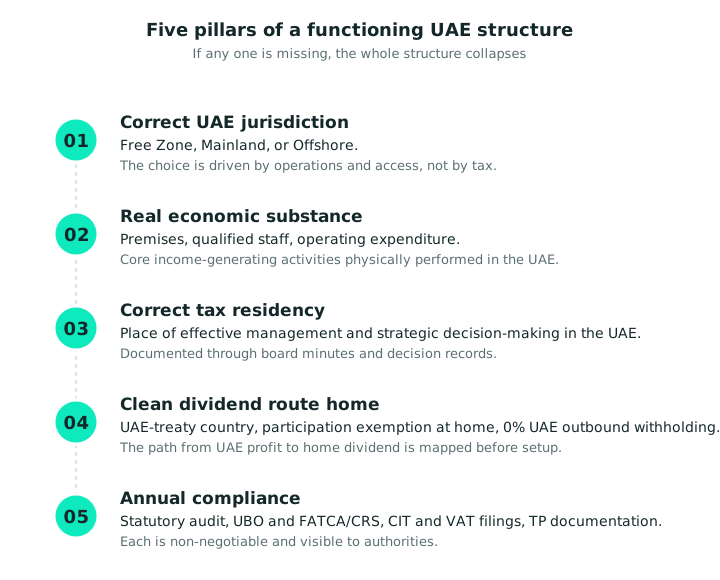
1. The correct UAE jurisdiction
Free Zone, Mainland, and Offshore are not interchangeable:
- Free Zone with QFZP potential is the right answer for most internationally-oriented businesses.
- Mainland licence is necessary where the business serves the UAE domestic market directly.
- Offshore structures (such as RAK ICC) are limited in scope and have been narrowing in recent years.
The choice is not primarily tax-driven; it is driven by the operational reality of the business. The six cumulative QFZP conditions are explored in QFZP conditions.
2. Real economic substance
Behind this term sits something straightforward: real premises in the UAE, qualified employees in the UAE, operating expenditure in the UAE proportionate to the business, and, perhaps most importantly, that the core income-generating activities are actually performed in the UAE, not elsewhere. This is the single most audited, most documented, and most misunderstood pillar.
With ESR discontinued and its logic absorbed into the CIT Law, substance requirements are now tied directly to whether the company qualifies for its claimed tax treatment. The key question is rarely whether there is some substance in the UAE, but whether the substance matches the claimed function. Holding companies, treasury companies, and IP companies each require a different substance profile. The substance framework, profiles for different entity types, and documentation requirements are in Substance rules in the UAE.
3. Correct tax residency of the company
Companies incorporated in the UAE are generally UAE tax residents by operation of law. What is decisive, however, is that the place of effective management of the company (the place from which directors or persons charged with management actually take strategic decisions) is in the UAE.
If strategic decisions are taken from the home country or from another European jurisdiction, the company can be treated as a tax resident of that country and taxed under its rules, regardless of where it is registered. The question is not about the shareholder; it is about who actually runs the company, and from where. The PoEM test, tie-breaker analysis under the typical EU member state to UAE treaty, and the documentation that supports a defensible UAE PoEM are in Place of effective management.
4. A clean route for dividends and other flows back to the home country
This is where the home-country side of the structure becomes decisive. The EU Parent-Subsidiary Directive does not apply to non-EU jurisdictions, including the UAE, but most EU member states operate bilateral participation exemption regimes in their domestic law that extend preferential treatment to dividends received from companies resident in jurisdictions with which the member state has a double tax treaty. The UAE qualifies as a treaty partner for the overwhelming majority of EU and EEA countries.
Practical impact
The exact conditions of the home-country participation exemption (minimum holding period, minimum shareholding percentage, qualifying-status requirements) vary by member state. The structural pattern is consistent across the EU: corporate-level dividend received from a UAE company resident in a treaty jurisdiction qualifies for participation exemption at home, and the UAE imposes no outbound withholding tax on dividends. The combined result is an effective 0% rate on the corporate dividend flow.
For the individual shareholder, the dividend received from the home-country company is taxed under domestic rules (the rate varies from 0% to over 40% across the EU, with many member states applying preferential rates for dividend income).
The home-country side is the domain of the client’s local tax adviser, who confirms the specific application of the participation exemption for the client’s structure. The architecture, however, is well established and widely used in practice. The dividend flow from the UAE to the home country, including three practical configurations, is in Withholding tax with UAE entities, the holding architecture is in UAE holding structure.
5. Compliance
Statutory audit, UBO reporting, FATCA/CRS obligations, corporate income tax filing, VAT registration and filing where applicable, and transfer pricing documentation. None of these are optional for a seriously structured entity. None of them are trivially handled from outside the UAE. The cost of doing this properly is real; the cost of doing it badly is considerably higher.
The framework for UAE transfer pricing from 2023, master/local file requirements, and coordination with the home-country TP regime is in Transfer pricing in the UAE.
Transfer pricing: the cost of waiting
In textbooks, transfer pricing is addressed at the start of the structure: comparability studies, master file, local file, intercompany agreements, and arm’s-length documentation prepared before the first intercompany invoice. The OECD recommends it. In practice, almost no one does this.
In reality, firms start thinking about transfer pricing the moment the first audit letter arrives. By then it is usually too late.
The recurring pattern
We say this with some hesitation, because it is not advice anyone wants to give publicly. Pretending otherwise, however, would not be useful. Across the firms we work with (mid-sized manufacturers, tech groups, international consulting firms), the same pattern recurs. TP documentation is either non-existent or formal-only, without real comparability work, until something forces the issue.
Why documentation has value even “in the drawer”
The reality is that when the moment to respond arrives, the taxpayer’s position depends on whether current documentation is ready. Without it, the taxpayer is on the defence. The tax authority can challenge intercompany pricing and, in most European jurisdictions, can set the price itself, typically to the taxpayer’s disadvantage.
With proper documentation, however, the dynamic shifts substantially: the burden of proof returns to the tax authority, which must demonstrate that the documented prices do not match market conditions. This is one of the most practical reasons to maintain at least a baseline level of TP documentation. It is not merely a formal obligation but a real legal position.
The UAE side from 2023
Since 2023, the UAE also has its own transfer pricing regime, aligned with the OECD Guidelines. Companies within the regime must complete TP disclosures in their UAE tax return and, above defined thresholds, prepare a master file and local file.
For a European group with a UAE subsidiary this means TP documentation is now required on both sides of the structure, and the two versions must be mutually consistent.
The pragmatic path
A reasonable minimum is a short, coherent TP policy in writing, supplemented by comparability analysis for the key intercompany transactions (intercompany services, financing, royalties), at a quality proportionate to the materiality of those transactions. It does not need to be a Big Four master file. It must, however, exist and be defensible. The worst position is to have nothing.
The reason most owners postpone this work is understandable. TP documentation has no visible payoff unless the tax authority asks for it, and they may never ask. It costs money upfront, requires information from the business, and produces a document that is filed and forgotten. In competition with other priorities, it loses every time, until the audit letter arrives and the entire calculation changes.
This is an area where we strongly recommend clients approach their home-country tax adviser proactively, before being asked. A short conversation about the current state of documentation, the materiality of intercompany transactions, and the gap between where the documentation is and where it should be is among the highest-return hours an owner can spend.
In-depth analysis of UAE transfer pricing, the five OECD TP methods, functional analysis, and coordination of home-country to UAE documentation is in Transfer pricing in the UAE.
When a UAE structure makes sense
A UAE structure costs real money, both at setup and in operations. Below a certain level of cross-border profitability, it spends more than it saves. This is arithmetic, not marketing, and an honest version of this conversation deserves space.
Fixed costs and minimum profitability
Annual fixed costs of a properly operated UAE structure (license, renewals, substance in the form of premises, employees, and operating expenditure, statutory audit, local and international tax obligations, corporate services) range in the tens of thousands of dollars per year. Specific amounts depend on the type of structure, the chosen Free Zone, the activity, and the intensity of required substance, and belong in a quotation, not in an article.
Find out what setting up a UAE company actually costs
Complete a short form to receive an indicative price estimate based on company type, visas, and scope of services.
Cost calculatorAs an indicative threshold: a UAE structure starts to make sense when the business owner can demonstrate annual profitability in the range of approximately EUR 180,000 to 200,000 from international or cross-border activity that can be legitimately attributed to the UAE entity based on substance and functional profile. Below this threshold, the structure’s costs absorb the tax saving and the return on energy and compliance burden slips into the negative. Above it, the structure starts to pay off, and at substantially higher profitability it can deliver substantial long-term benefit.
The phrase “legitimately attributed” does important work in that sentence. A UAE structure is not a tool for paper profit shifting. It is a tool that allows business activity to be arranged so that part of the functions, decisions, and risks sits in the UAE, and consequently part of the profit. The legitimacy of that attribution rests on functions, not on invoicing.
Activities where a UAE structure typically makes sense
Some business models fit the UAE naturally. The most common categories are described below. Detailed analysis of each model is in the dedicated cluster articles.
Digital and knowledge-based businesses
- IT and SaaS firms. Digital product that can be delivered from anywhere. The clientele can be global, regional, or even purely domestic. What matters is not where the customers sit, but whether the UAE company has real operations and PoEM in the UAE. The framework for SaaS businesses is in UAE tax setup for SaaS founders.
- International consulting and professional services. Managerial, tax, legal, technical, educational, creative.
Group-level functions for an international group
- Holding functions, treasury, financing, and headquarter services. The framework for headquarter and treasury services is in UAE headquarter services, holding architecture is in UAE holding structure.
- Family office and private wealth management.
Trade and logistics
- International trade in goods and commodities.
- Logistics, distribution centres in designated zones, and maritime trade. See UAE distribution hub for detail.
- Operation and management of ships and aircraft.
Manufacturing and industry
- Manufacturing in the UAE, defence industry, energy, and renewable resources.
- Agriculture, food processing, and beverages.
- Medical technologies and medical devices.
Intellectual property
- IP holdings, subject to DEMPE functions and modified nexus. Detail is in Exit tax on IP transfers to the UAE.
VAT on cross-border digital services is covered in VAT on digital services from UAE to EU.
Activities prohibited in the UAE
The second category is different. Here it is not an economic question but a hard legal line. The UAE either prohibits these activities entirely or licences them through a very narrow regime that ordinary business owners do not enter:
- Gambling and online betting. Federally prohibited. The only exception is a narrowly defined commercial casino licensing regime through the General Commercial Gaming Regulatory Authority in Ras Al Khaimah, not available to general clients.
- Privacy-coin crypto-assets and anonymisation tools. Monero, Zcash, and similar virtual assets that obstruct transaction or ownership tracing, including mixers, are categorically prohibited in the UAE. For the legitimate UAE crypto holding structures described in Myth 5, this list is the exception. Standard transparent assets such as Bitcoin or Ethereum are not affected.
- Cannabis, CBD, and hemp products outside a narrow pharmaceutical regime. The federal framework permits only medical applications through licensed pharmaceutical players. Commercial CBD oils, nutritional supplements, and hemp products for the standard business owner remain out of reach.
- Unlicensed financial products. Unauthorised investment advice, fund management, retail forex, CFDs, and binary options without an SCA, VARA, or DFSA licence.
Where VAT actually becomes a cost, and where it does not
This point is routinely misstated in both directions in public articles on UAE structures, so it is worth setting out precisely.
Reverse charge is neutral in itself. When a UAE company invoices a European business customer, the customer self-assesses the VAT and deducts it in the same return. Nothing is lost. A cost appears only where the customer cannot deduct, that is, where the customer carries out exempt activities or recovers input VAT only through a partial recovery ratio (healthcare providers, educational institutions, banks, insurers, some social services). For that customer, the non-recoverable portion is a genuine cost.
Two consequences follow, and they matter more than the mechanism itself.
- This is not a UAE disadvantage. The same exempt customer would carry exactly the same non-recoverable VAT on a service invoiced from a Cypriot, Dutch, or any other EU group entity, because cross-border B2B services are reverse-charged there too. A UAE entity is not worse placed than an EU entity. The variable is the recovery position of the recipient, not the jurisdiction of the supplier.
- Two narrow differences do exist. A supplier established outside the EU using the OSS Non-Union scheme has no access to the EUR 10,000 micro-threshold available to EU-established providers. And a domestic supplier below the VAT registration threshold can invoice an exempt customer with no VAT at all, which no cross-border supplier, UAE or EU, can do.
The practical consequence for structuring is therefore narrower than it is usually stated. What has to be mapped is the VAT recovery position of the entity that will receive and pay the UAE invoice, not the customer base as a whole. Where that entity is exempt or partially exempt, non-recoverable VAT can outweigh the corporate tax saving, and that arithmetic belongs in the analysis before the structure is set up, not after. The full framework for EU VAT on digital services from UAE entities is in VAT on digital services from UAE to EU.
An honest summary of this section
The decision whether a UAE structure makes sense for your business rests in practice on four questions:
- Whether part of your functions and decisions can be legitimately attributed to real operations in the UAE.
- Whether the VAT recovery position of the receiving entity changes the arithmetic.
- Whether profitability exceeds the threshold below which structure costs exceed the saving.
- Whether you are willing to build substance and place of effective management honestly from day one.
A yes to all four means the UAE can be a powerful tool for you. If you hesitate on any one, an initial consultation is precisely for working through it together, before deciding.
A serious adviser will raise these questions on the first call, before any discussion of licences begins.
What’s changed and what’s still changing
The regulatory framework around UAE structures has moved more in the past three years than in the preceding ten. The movement has not stopped. A structure that was optimal in 2022 may no longer be optimal today, and a structure optimised today will need annual review.
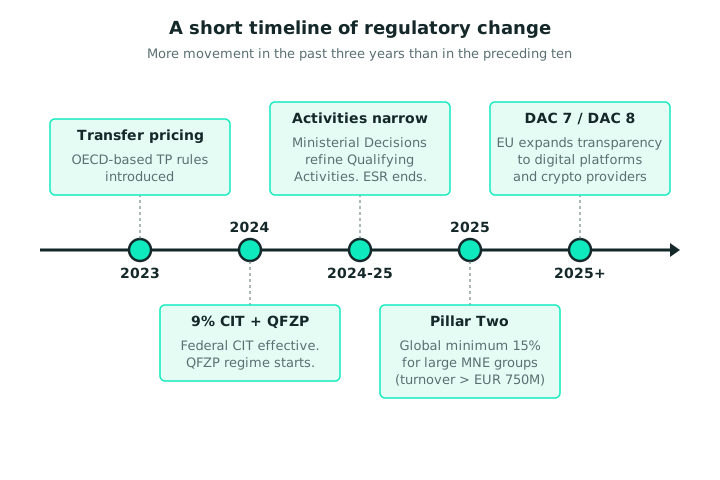
A short timeline of the most important changes
- 2023. The UAE introduces transfer pricing rules based on the OECD Guidelines. Disclosure obligations apply broadly, with master file and local file requirements above defined thresholds.
- 2024. UAE federal corporate income tax takes effect at 9% on profits above AED 375,000. The QFZP regime starts, preserving 0% on qualifying income subject to conditions.
- 2024 and 2025. Ministerial Decisions progressively refine Qualifying Activities, Qualifying Income, and Excluded Activities. ESR is discontinued in its original form; substance requirements move directly into the CIT Law.
- 2025. The UAE launches the OECD’s Pillar Two regime for large multinational groups with consolidated turnover above EUR 750 million, introducing a top-up mechanism to the 15% global minimum effective rate. The overwhelming majority of European business owners are not affected, but groups approaching this threshold must plan ahead.
- 2025 and beyond. EU tax transparency rules continue to expand. DAC 7 applies to digital platform operators, DAC 8 covers crypto-asset service providers. CRS automatic information exchange continues to deepen.
Direction of travel
The direction is clear: more information exchanged automatically across borders, more substance required for preferential regimes, less tolerance for structures that exist only on paper. This is not specifically a UAE trend. It is a global direction, and the UAE is aligning with it rather than being the exception to it.
Practical implication
For every European business owner with a UAE structure: the structure needs proper annual review. Not formal license renewal, but a genuine assessment of whether the structure still does what it was designed for, whether substance still matches functions, whether new regulations have shifted the analysis, and whether the supporting documentation is current. This is not optional. It is the price of doing business in a jurisdiction that has moved from static to dynamic.
Who does what: the team that actually builds a working structure
A UAE structure is rarely the work of a single provider. It spans two jurisdictions and several disciplines, and no honest provider claims to cover all of it alone. We say this plainly because it shapes how we work: we operate alongside your existing advisers, and we welcome their involvement rather than treating it as interference. In practice the outcome is better when they are in the room from the start.
Your home-country tax adviser
Domestic corporate income tax, CFC analysis at company level, participation exemption for foreign dividends, exit tax, home-country transfer pricing documentation, reporting obligations, and withholding tax analysis all sit with an adviser who knows your full domestic position. If you already work with one, we coordinate with them directly. If you do not yet have one, that is no barrier to starting the conversation; helping you identify the right adviser, or coordinating with one you appoint later, is part of what the early stage is for.
Your home-country attorney
Contractual architecture on the home-country side (shareholder agreements, intercompany service agreements, royalty and loan agreements, and the corporate governance of home-country entities) sits with a qualified local attorney. Well-drafted contracts are what later allow substance, transfer pricing, and commercial logic to be evidenced.
The UAE corporate services provider
The UAE side (company formation, license selection and renewal, UAE corporate tax and VAT obligations, substance setup, UBO reporting, statutory audit coordination, banking relationships, residence visas, and UAE-side transfer pricing documentation) sits with a licensed UAE corporate services provider. This is the role INCORPORTAS performs.
Where we sit
We cover the UAE side, and we do not present ourselves as a substitute for your home-country tax adviser. What we add is the ability to speak the same language as that adviser: the author of this article is an EU-qualified attorney with a practice in international tax planning, which makes cross-border coordination materially easier than it tends to be when the two sides of a structure are handled in isolation.
INCORPORTAS is also anchored in the European business community in the UAE. The author serves on the board of the Slovak Business Council at the Dubai Chamber of Commerce. For European clients this means a provider operating transparently, through established institutional channels, with a direct connection to the official business infrastructure between Europe and the UAE.
Working with your existing advisers is the rule, not the exception. In most engagements the first call includes you, your tax adviser, and INCORPORTAS together, and the structure takes shape jointly from that first conversation.
How to start: the first step is not to set up a company
The first step in considering a UAE structure is not the choice of Free Zone, the company name, or the license application. It is a sober look at the business itself.
Questions worth thinking through first
Before any conversation about licenses begins, it helps to have a view on the following points, or at least clear questions about them:
- Business model. What does your business actually do, and who are its customers? What share of revenue is cross-border, and where is it geographically concentrated?
- Profitability from international activity. What share of profit can credibly be attributed to functions, decisions, or assets that can legitimately move to the UAE or be located there? The question is not “how much profit could I shift,” but “what part of my business has a genuine international dimension that UAE substance would justify.”
- Ownership structure. Who owns the business, and through which entities? Are the shareholders individuals or companies, and in which countries?
- Willingness to move functions and decision-making. Is the owner genuinely willing to place real functions in the UAE (decisions, people, operations, or at least specific work packages) and consider who the directors will be and from where the company will actually be run? If the answer is no, the UAE structure will not work, and a serious adviser will say so on the first call.
- Home-country tax adviser. Who currently handles your tax matters at home? If you already have an adviser, are they available to join the discussion? If you do not, putting the right one in place is among the first things we help with.
With preliminary answers to these questions in hand, the natural next step is an initial consultation: a focused discussion of your business and personal situation, deep enough to establish whether a UAE structure makes sense for you, what it would look like in outline, and how it would sit alongside your existing European advisers. If that discussion shows the structure does not make sense, we say so directly. That happens, and saying it is part of the work.
The difference between a successful UAE structure and an expensive mistake usually lies in the initial analysis.
We will assess whether the UAE makes sense for your specific business.
Book a consultationWhat to take from this article
UAE structures remain a legitimate and valuable tool for established European business owners with genuine international activity. Used wisely, they support tax efficiency, regional market access, the architecture of an international group, and long-term wealth structuring. Used incorrectly, they become expensive traps that bring more problems than they solve.